What is moss stitch in crochet?
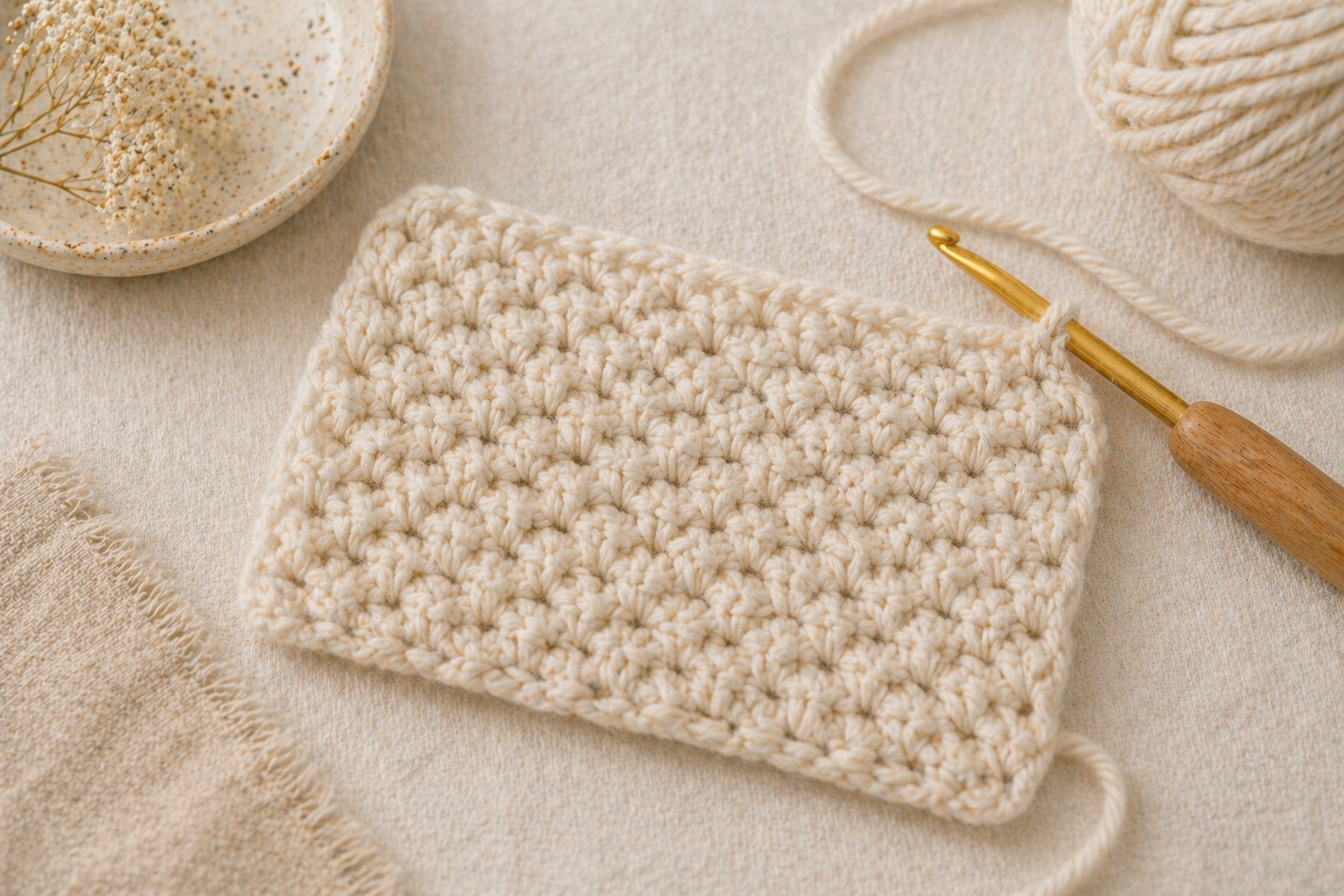
Moss stitch (also called linen stitch or granite stitch, depending on who you ask) is a simple repeating pattern that alternates single crochet and chain stitches to create a tight, woven-looking fabric. It's not technically a single stitch — it's a stitch pattern — but it's taught as 'moss stitch' because the repeat is tiny and memorable.
The fabric looks like woven linen from a distance, which is why it's so popular for throws, cushion covers and scarves. It reads as polished and deliberate, but the skills required are genuinely beginner-level: if you can chain and single crochet, you can moss stitch.
Note: 'moss stitch' in knitting refers to something completely different. This guide is specifically about the crochet version.
What moss stitch looks and feels like
Visually, moss stitch produces a subtle checker-board texture. Single crochets and chain spaces sit offset from row to row, creating a quiet woven effect. Best viewed in solid, mid-tone yarns — busy variegated yarns hide the texture.
As a fabric, it's dense but has good drape. It doesn't stretch much (which is why it's not used for close-fitting garments) but holds shape beautifully for blankets, bags and home textiles. It's warmer than single crochet alone because the alternating chain spaces trap air.
Moss stitch uses slightly more yarn than plain single crochet — budget about 15–20% extra yarn for any moss-stitch project compared to the same project in single crochet.
How to crochet moss stitch — step by step
What you'll need: a 5mm crochet hook (we use the Clover Amour for its ergonomic handle; full kit breakdown on our crochet starter kit page), a ball of smooth DK yarn in a mid-tone colour, scissors and a tapestry needle for weaving in ends. Pick a light colour while you learn — moss stitch is hard to see in dark or variegated yarns.
Before starting, make sure you're confident with chain stitch, slip stitch and single crochet. If any of those feel wobbly, our basic crochet stitches for beginners guide covers them in detail.
Step 1. Make a starting chain with an even number of stitches. For a small swatch, chain 20. (Most moss stitch patterns use an even-numbered foundation.)
Step 2. Row 1: chain 1 extra (this counts as a turning chain). Skip the first chain. Work 1 single crochet in the next chain. Chain 1. Skip the next chain. Work 1 single crochet in the next chain. Chain 1. Continue across the row — single crochet, chain 1, skip, single crochet, chain 1, skip — until you reach the end. You should end with a single crochet.
Step 3. Turn your work. Chain 1 (this is your turning chain).
Step 4. Row 2: work 1 single crochet into the first chain-1 space from the previous row (not into the single crochet itself). Chain 1. Skip the next single crochet. Work 1 single crochet into the next chain-1 space. Chain 1. Skip. Continue across.
Step 5. Every subsequent row is identical to row 2: single crochet into each chain-1 space, with chain-1 between. Turn at the end of each row with a single chain-1.
That's the entire stitch pattern. The only skill is learning to work into the chain-1 space rather than into the stitch itself — which clicks within a few rows.
Common beginner mistakes (and quick fixes)
Working into the single crochet instead of the chain-1 space. Your rows will start to skew and the woven texture won't appear. Fix: pause after each single crochet and check you're about to insert the hook into a chain-1 space, not into a stitch.
Forgetting the turning chain. Skipping the chain-1 at the start of each row makes your edges pucker. Fix: say 'chain 1, turn, single crochet into the space' out loud for the first few rows.
Tension too tight. Moss stitch feels tight under normal tension because the chain spaces can close up. Relax your grip consciously — the chain-1 spaces should be visible, not squeezed shut.
Variegated or fuzzy yarn making the pattern invisible. Fix: start with smooth mid-tone DK. Save variegated yarns for your second or third moss stitch piece.
Three projects that shine in moss stitch
A moss-stitch washcloth or dishcloth. Quickest project to practise the stitch. Use 100% cotton DK (Paintbox Simply Cotton DK at around £2.50 per ball) on a 5mm hook. 2–3 hours of work. A perfect gift when made in a set of three.
A moss-stitch baby blanket. The next project up in scale. Moss stitch looks luxurious at baby-blanket size and works up quickly because of the larger repeat. Use aran weight yarn for warmth without too much weight.
A moss-stitch market bag or tote. The dense fabric gives good structure. Pair with sturdy straps and a lined interior for a gift-worthy result.
What to try next after moss stitch
Moss stitch is an excellent stepping-stone to slightly more complex textured stitches. Three natural next steps: the waffle stitch (deep 3D texture using front/back post double crochet), the bobble stitch (five double crochets closed together for a tactile bump), and the shell stitch (five double crochets worked into one stitch for a fan).
If you want to keep practising before moving up, work a moss-stitch scarf (10–12 hours) or a cushion cover (8–12 hours). More volume means more muscle memory.