What is puff stitch in crochet?
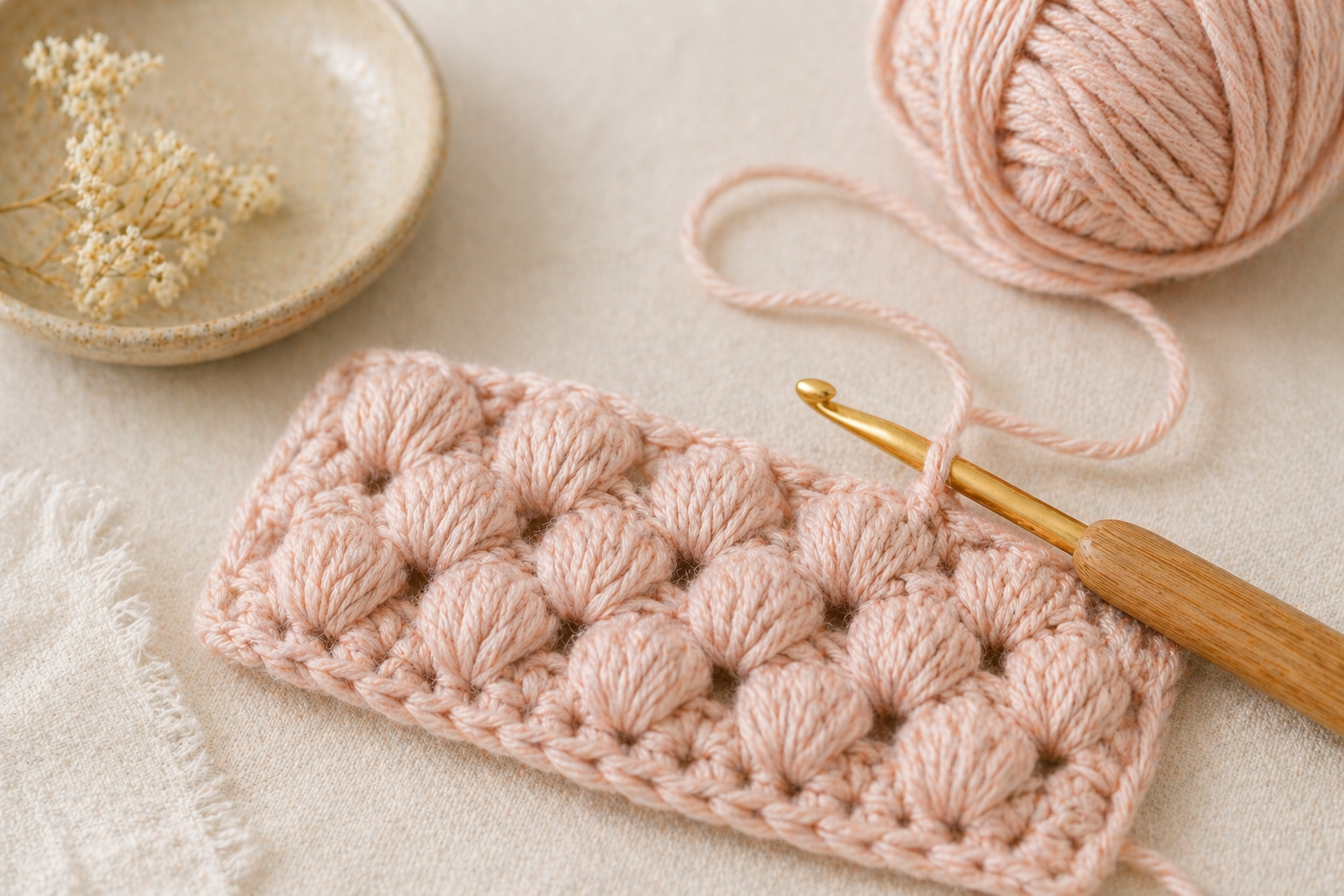
A puff is a rounded 3D cluster formed by pulling up multiple long loops of yarn into one stitch, then yarn-overing and pulling through all of them at once. Each 'puff' is usually made from 3–5 yarn-over-pull-up repeats. The loops stack softly rather than snapping into a tight knot, giving puff stitch its characteristic cosy, squishy quality.
Puffs are one of three closely-related 'cluster' stitches — puff, bobble, and popcorn. All produce 3D texture but feel different: bobbles are sharper and more defined, popcorns pop forward more prominently, and puffs are rounder, softer and more cloud-like.
Puff stitch is especially popular in baby blankets, headbands, and textured accessories where softness matters as much as shape.
What puff stitch looks and feels like
Visually, puffs produce a regular pattern of soft rounded bumps. In a well-worked puff-stitch fabric, each puff catches light slightly differently, giving the surface a quiet glow. Great in solid pastels and mid-tones; variegated yarn hides the shape.
As fabric, puff stitch is warm, plush and squishy. Noticeably thicker than plain double crochet — you trade off drape for texture. Uses roughly 30–40% more yarn than the same project in double crochet, because each puff stacks 3–5 stitches' worth of yarn into one point.
Puff stitch doesn't drape well, so it's unsuitable for close-fitting garments or flowing scarves. Perfect for structured items: cushion covers, baby blankets, ear warmers.
How to crochet puff stitch — step by step
What you'll need: a 5mm crochet hook (we use the Clover Amour for its ergonomic handle; full kit breakdown on our crochet starter kit page), smooth DK or aran yarn, and scissors. A soft wool-blend or cotton yarn works best for seeing the puff shape clearly. Avoid thin 4-ply or fuzzy yarn — both muddle the texture.
Prerequisite: comfort with chain, single crochet and yarn-overs. If those feel wobbly, our basic crochet stitches for beginners guide covers them first.
Step 1. Make a foundation chain of 20 stitches, then work 2 rows of single crochet to give yourself a firm base.
Step 2. Chain 2 (this counts as the start of your first puff). Turn your work.
Step 3. Yarn over. Insert hook into the next stitch. Yarn over. Pull up a long loop (longer than for a double crochet — aim for ~1 cm tall). You now have 3 loops on your hook.
Step 4. WITHOUT closing, repeat step 3 two more times into the SAME stitch: yarn over, insert into the same stitch, yarn over, pull up a long loop. After three repeats, you should have 7 loops on your hook (the original plus three pairs from the puff).
Step 5. For a fuller puff, repeat step 3 one or two more times — a 4-loop puff has 9 loops on hook; a 5-loop puff has 11 loops. Most patterns use a 3-loop puff.
Step 6. Yarn over. Pull through ALL the loops on your hook in one motion. The puff closes into a soft cluster. If the pull-through feels hard, ease it through in two steps: pull through all but two loops, then yarn over again and pull through the last two.
Step 7. Chain 1 to 'lock' the puff in place. This chain-1 is important for puff stitch — it gives each puff room to sit plump rather than being squashed by the next stitch.
Step 8. Skip the next stitch on the row below. Work your next puff into the following stitch.
Step 9. Continue across the row: puff, chain 1, skip 1, puff. End with a puff or a single crochet as the pattern dictates.
Step 10. Turn and work a plain single crochet row on the return. Puffs push through to what becomes the right side.
Puff stitch vs bobble stitch vs popcorn stitch
All three are raised cluster stitches, but they produce different textures and are worked slightly differently.
Puff stitch: made with yarn-overs and long pulled-up loops. Soft, rounded, cloud-like. Best for baby blankets and cosy accessories.
Bobble stitch: made with incomplete double crochets closed in one pull-through. Firmer, more defined, polka-dot-like. Best for headbands and textured cushion covers.
Popcorn stitch: made with five complete double crochets, hook removed and re-inserted into the first double crochet to close. Most prominent, most 3D. Best for statement pieces and heavy textures.
If you've already worked bobble stitch, puff stitch feels like a softer, rounder sibling. Both are worth learning — they're used interchangeably in many patterns but produce genuinely different fabrics.
Common puff stitch mistakes (and quick fixes)
Pulling loops up too short. Puff loops should be about 1 cm tall — noticeably longer than a double crochet. Short loops make a flat, bobble-like puff instead of a soft round one. Consciously pull the yarn up taller on each yarn-over.
Pull-through too tight. When closing the puff, pull the final yarn-over through firmly but not with a jerk — a gentle snug pull keeps the puff rounded. Over-tightening flattens it.
Forgetting the closing chain-1. Each puff needs a chain-1 after closing to hold its shape. Skipping it crushes the next puff against this one.
Pull-through feels impossible. If you can't get the yarn through 7+ loops in one motion, split it: pull through all but the last two loops first, then yarn over and pull through the last two. Same result, easier execution.
Three projects that shine in puff stitch
A puff-stitch baby blanket. The classic puff-stitch project. The soft squishy texture is comforting to hold and looks luxurious. Use washable aran yarn (Drops Paris DK or Lion Brand Baby Soft). A 60×80 cm baby blanket takes around 20–30 hours of work.
A puff-stitch headband or ear warmer. Faster to finish than a blanket and giftable. Use chunky wool-blend yarn (Drops Nepal aran). 3–5 hours of work.
A puff-stitch cushion cover. Pairs beautifully with plain single crochet borders. A 40 cm cushion cover takes 12–16 hours.
What to try after puff stitch
Three natural next stitches: the bobble stitch (firmer, sharper cousin of puff), the waffle stitch (deep geometric 3D texture using front/back post double crochet), and the shell stitch (five double crochets into one stitch for a decorative fan).
If you want to stay with rounded textures, popcorn stitch is a natural extension of puff — same rounded aesthetic, different closure mechanic for a slightly more defined bump.